 thearchivist.fun
A small amplifier changes the scale of electronics
The point-contact transistor demonstrated a practical alternative to vacuum-tube amplification.
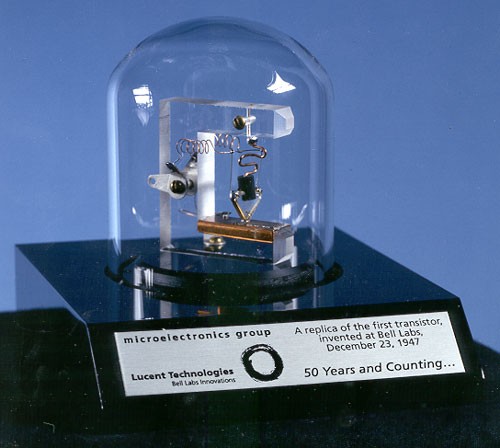
Context and provenance
At Bell Labs in December 1947, John Bardeen and Walter Brattain obtained amplification from a small piece of germanium touched by closely spaced contacts. Their experiments followed attempts to understand how electrical conditions at a semiconductor surface affected its behavior. The successful device was demonstrated internally before Bell Labs announced the transistor publicly in 1948. It was delicate and unlike the integrated circuits familiar today, but it established that amplification could occur in a solid-state device. The development grew from a research program concerned with replacing unreliable tubes and switches in communication equipment, placing telephone infrastructure inside the prehistory of digital media.
Why it matters
Editorial perspective: Miniaturization is a cultural force as well as an engineering achievement. The eventual ability to place computing inside affordable personal devices depended on changes at a scale almost invisible to their users.