 thearchivist.fun
The Ice Bucket Challenge links imitation to action
A repeatable video challenge turned personal networks into an awareness and fundraising campaign.
Context and provenance
The 2014 ALS Ice Bucket Challenge combined a visible action with a request that other people continue it. Participants filmed an ice-water dousing, named others, and connected the performance to support for people affected by ALS. The ALS Association's origin account emphasizes Anthony Senerchia, Pat Quinn and Pete Frates and the personal networks around them. This is an account of the movement's connection to ALS, not a claim that these people invented every earlier cold-water dare. [1]
The Association reports that the challenge generated 115 million US dollars for its national office in 2014. That qualification is essential: a total for one organization is not automatically a worldwide total, and a fundraising receipt is not the same measure as money already spent or a clinical outcome. Its financial explanation distinguishes the initial influx from subsequent commitments to research, care and other work. [2]
ALS Canada's account documents a separate national research program and describes how challenge donations supported Canadian research investment. Reading the two organizations together makes the decentralized character of the event clearer. People recognized a shared performance, but funds flowed to different recipients in different places. An archive should identify the organization, currency, period and category whenever it records a donation figure. [3]
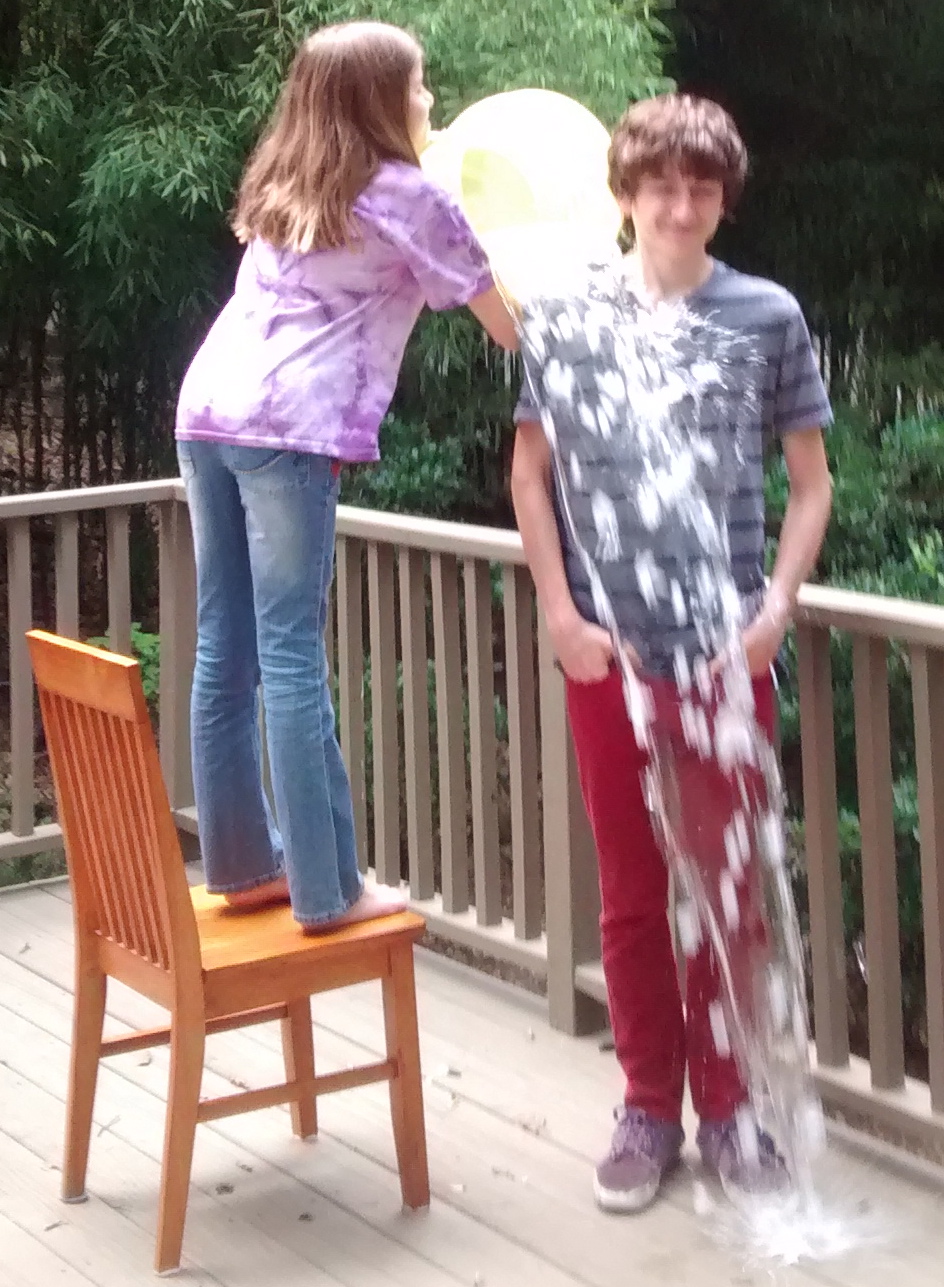
Our accompanying photograph documents a participant performing the challenge with his sister on 17 August 2014. The Commons record credits Mx. Granger and supplies a CC0 dedication. It is a contemporary example of participation, not a photograph of the movement's founders. Its evidentiary value is modest but concrete: it shows a recognizable action and an ordinary domestic setting during the period of widespread circulation. [4]
Editorial reading: the challenge joins imitation to nomination. The action is simple enough to recognize across many individual recordings, while named invitations provide a reason for another recording to exist. Viewers encounter both a completed performance and an unfinished social obligation. Different locations, participants and staging choices make each version personal without requiring a wholly new concept.
The public gesture and the cause should remain connected in the record. A compilation of dramatic reactions can preserve spectacle while dropping donation links, explanatory captions and accounts from people living with ALS. Conversely, a financial report can measure funds without preserving why an ordinary person decided to participate. An informative archive needs both types of evidence and should not pretend that one substitutes for the other.
Participation counts, video views, donations and research results are different measurements. A person can watch without participating, participate without donating, or donate without posting. This dossier therefore does not calculate a conversion rate from incompatible figures or claim that a viral event directly produced a particular cure. The historical achievement can be documented without flattening the long work of patients, families, clinicians, researchers and support organizations into a single cheerful internet moment.
For individual submissions, keep the upload date, nominated people when publicly stated, linked recipient, caption and creator credit. Avoid inferring someone's health status from participation. A recreated challenge in a later year belongs in its own dated record, even when its visual script resembles the 2014 campaign.
Transmission timeline
- 2014
The challenge spreads through networks associated with Senerchia, Quinn and Frates.
- 2014-08-17
Mx. Granger’s photograph records a participant and his sister performing the challenge.
- 2014
The ALS Association reports 115 million US dollars generated for its national office during the year.
Variants and adaptations
- Personal nomination video
A participant records the action and invites named people to continue.
- Group or staged performance
A recognizable action is adapted to a team, workplace or public setting.
- Later revival
A subsequent campaign must retain its own date, recipient and purpose instead of inheriting all 2014 claims.
Why it matters
A repeatable performance became a distributed invitation to support a cause; its history requires both cultural evidence and carefully scoped institutional reporting.
What remains uncertain
Institutional fundraising claims are attributed to their organizations. This is a cultural history, not medical advice or an independent audit of financial or clinical outcomes.
Sources and evidence
- ALS Association: how the challenge started
Role of Senerchia, Quinn, Frates and their networks.
- ALS Association: impact on its finances
115 million US dollars for the national office in 2014 and later commitments.
- ALS Canada: impact of donations
Distinct Canadian research investments and recipients.
- Mx. Granger: Ice Bucket Challenge photograph
Date, depicted participation, authorship and CC0 dedication.

Editorial review: 2026-09-23. New evidence may change this account.