 thearchivist.fun
Doge turns a look into an inner voice
Kabosu's photograph anchored a playful caption style that outgrew any single image.
Context and provenance
Doge begins with a particular photographed animal but becomes a broader way of assigning an inner voice to a dog. Atsuko Sato's post dated 13 February 2010 survives on her blog, among ordinary accounts of home life, meals and time spent with Kabosu. Returning to that page restores something that the isolated meme often loses: the photograph belonged to a continuing relationship between a person and an animal, not to a template library created for anonymous use. [1]
Know Your Meme reconstructs the later circulation of the photograph and the development of the Doge style across sites. The familiar form places short, colorful phrases around a Shiba Inu image, often using deliberately unexpected combinations of intensifiers and nouns. The entry also distinguishes the earlier use of the word doge from the later visual meme. A word's documented appearance does not automatically date the photographic format. [2]
Sato's continuing blog identifies Kabosu as a rescue dog and records her death on 24 May 2024. This is first-person evidence about the animal behind the image. It does not make every later dog photograph, token logo, fan drawing, or meme caption part of one authorship claim. A respectful archive keeps the named subject and photographer visible even when discussing a form that millions of other people helped transform. [3]
Editorial reading: Doge's humor often comes from a mismatch between emotional confidence and unusual language. The dog appears to have an elaborate internal commentary, but that commentary arrives in small fragments rather than a coherent speech. Scattered placement allows the reader to move among reactions. The resulting voice can seem impressed, doubtful, distracted or pleased depending on the words and the context in which the image is posted.
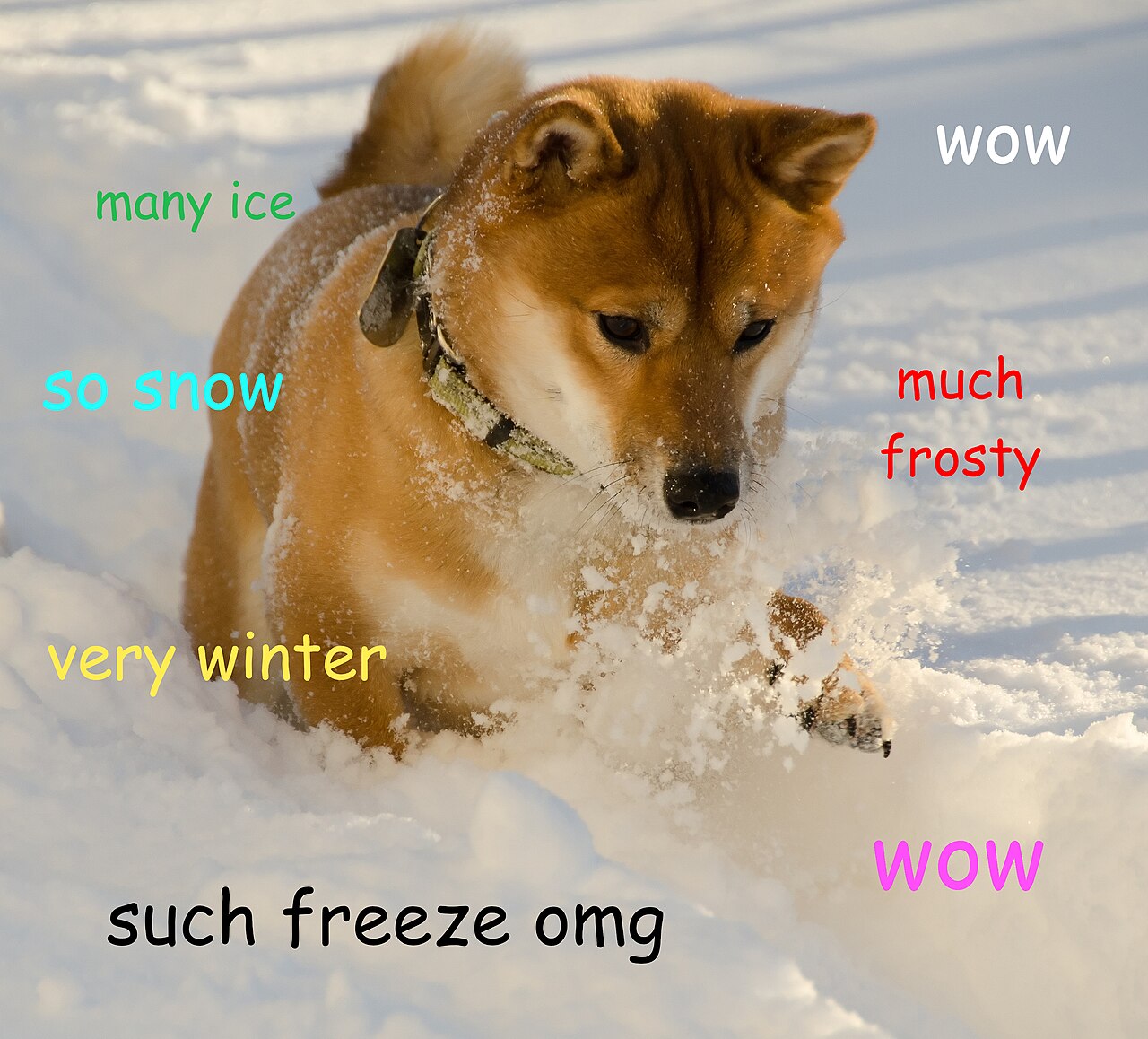
A useful comparison separates the photograph from the style. The same photograph can carry entirely different captions; the same caption style can be applied to another picture. A cropped reaction image may preserve only the glance and omit the text. These are relationships to document, not reasons to merge every version into one undifferentiated object. Our locally preserved licensed image is labeled as a format example; it is not represented as Sato's original 2010 photograph.
Later financial and commercial uses create another provenance layer. A product can borrow the name or look without becoming the origin of the meme. Ownership of a particular digital token does not by itself explain who took a photograph, who wrote a caption, or which license governs an archive's copy. Those questions require their own evidence and should remain separate from cultural recognition or price.
For an individual specimen, retain the full source page, caption, image credit, and date of capture. Compare the visible picture against the creator's page before assigning the animal's identity. The surviving repost chain is incomplete, so an early accessible copy is better described as the earliest found during a stated search than as an unquestionable first. That phrasing preserves what is known without letting certainty grow merely because an image is familiar.
Transmission timeline
- 2010-02-13
Sato publishes the blog post containing the familiar Kabosu photographs.
- 2013
The captioned Doge format gains prominent circulation in the chronology assembled by Know Your Meme.
- 2024-05-24
Sato records Kabosu’s death; the memorial remains part of the creator’s blog.
Variants and adaptations
- Captioned photograph
Short scattered phrases supply an imagined canine inner voice.
- Textless reaction
A crop can rely on the glance without retaining the characteristic caption style.
- Style transferred to another image
A different picture can reuse the verbal and typographic convention; it is a distinct specimen.
Why it matters
Doge demonstrates how a domestic photograph becomes a flexible collective voice while retaining a specific subject, photographer and source context.
What remains uncertain
The original blog is strong evidence for Sato’s publication, but it does not supply a complete repost chain or identify every caption author. The local illustration is an example, not the original photograph.
Sources and evidence
- Atsuko Sato: What is for dinner tonight?
The dated 13 February 2010 post and its domestic context.
- Know Your Meme: Doge
Distinction between word usage, photographic source and later captioned circulation.
- Atsuko Sato: Kabosu blog
Rescue-dog context and dated memorial.
Original works and visual references
These links lead to the original publications. Linking does not grant permission to reuse their images.
- See the original 2010 blog photographs
Original publication context for the familiar Kabosu image.
Photographs by Atsuko Sato; linked at the creator’s site, not copied here.
Editorial review: 2026-09-23. New evidence may change this account.