 thearchivist.fun
LOLcats give pictures a shared dialect
Cat photographs and irregular captions created a recognizable language for collaborative humor.
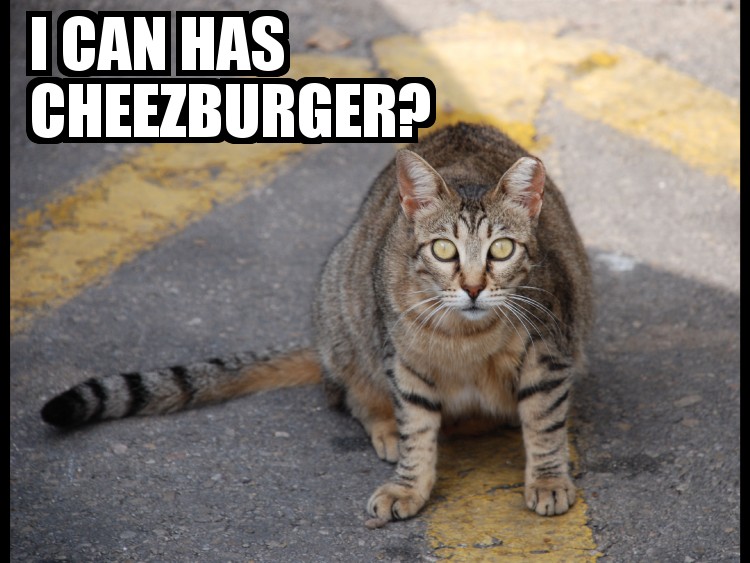
Context and provenance
LOLcats are better described as a participatory captioning practice than as a single photograph. A cat image becomes a staged voice: the caption attributes wants, complaints, misunderstandings, or grand plans to an animal that did not write the text. The deliberately irregular English helps distinguish that imagined voice from an ordinary human explanation. The photograph supplies posture and expression; the caption converts those visual cues into a small story.
A 2008 interview with Eric Nakagawa and Kari Unebasami recounts how sharing amusing cat images led to I Can Has Cheezburger in early 2007. The interview also records the practical pressure of incoming submissions and the site's subsequent purchase by Ben Huh. It supports the history of a prominent publishing hub, not a claim that the founders invented captioned cats or every linguistic convention associated with them. [1]
Anil Dash's April 2007 essay is a contemporary response to the practice. He argues that the apparent bad grammar has recognizable conventions: some captions feel appropriate to the invented cat voice while others do not. The essay is useful evidence that participants were already reflecting on style as the form circulated. It should be read as a situated cultural observation rather than a formal grammar adopted by all contributors. [2]
In a later interview, Huh describes a publishing business based on community contributions and a network of related humor sites. This adds another layer to the artifact's history. A playful image exchanged among friends, a selected front-page submission, and a product in an advertising-supported network can have the same caption while occupying very different social and commercial settings. Platform success does not resolve who took the photograph or who first wrote its words. [3]
Editorial reading: the format lowers the cost of participation without eliminating skill. A successful caption usually notices something specific in the photograph and adds a voice that remains brief enough to register at a glance. Repetition teaches readers the convention. Variants can depart from it because audiences already know what is being changed. The joke is therefore partly in the individual image and partly in familiarity with other examples.
A responsible archive separates at least three credits: photographer, caption author, and publishing or collecting site. A repost may preserve one and drop the others. Our licensed visual examples illustrate the format and retain the available file credits; their presence should not be read as a declaration that they are the first LOLcats. Comparing the cheeseburger request with a different cat caption also avoids allowing one emblematic image to stand in for the whole practice.
For researchers, surrounding comments and submission rules can be as revealing as the picture. They show how a community decided whether a caption worked, which spellings became recognizable, and who performed selection. The surviving record is uneven because informal image-sharing often outlives its original thread. A careful collection can document examples and relationships without inventing a single author for a collective dialect.
Transmission timeline
- 2007
Nakagawa and Unebasami launch I Can Has Cheezburger after sharing captioned cat images.
- 2007-04-23
Anil Dash publishes a contemporary discussion of recognizable LOLcat language conventions.
- 2009
Ben Huh discusses the contribution-driven publishing network in an interview.
Variants and adaptations
- Object request
A cat appears to ask for something, with the caption supplying a comic voice.
- Claim or complaint
The same visual grammar can express possession, frustration or exaggerated ambition.
- Community remix
Contributors reuse a recognized pattern while substituting a photograph, speaker or situation.
Why it matters
LOLcats reveal how repetition, a shared invented voice and community selection turn ordinary photographs into a collaborative expressive form.
What remains uncertain
No complete chain from a first captioned cat to all later LOLcats is established. Hub founders, photographers, caption writers and individual uploaders must not be conflated.
Sources and evidence
- WIRED: interview with the I Can Has Cheezburger founders
Founders, early sharing, submissions and sale.
- Anil Dash: Cats Can Has Grammar
Recognition of recurring caption-language conventions.
- Fast Company: Ben Huh interview
Community submissions and publishing-network development.
Editorial review: 2026-09-23. New evidence may change this account.